In hyperspectral imaging, effective pixels, and spot size significantly impact a system’s performance. A common misconception is that more effective pixels or smaller spot sizes automatically translate to superior imaging. In industrial settings, however, optimal performance often requires balancing pixel density with data reliability for real-time processing. This article explains why a larger spot size and fewer effective pixels can offer advantages in many industrial applications.
Effective Pixels vs. Spot Size
Let’s consider two hypothetical hyperspectral cameras with the same pixel pitch but different optical spot size:
- Camera A uses a 1-pixel spot size, which provides 640 effective pixels with 640 spatial pixels.
- Camera B utilizes a 2-pixel spot size, delivering 320 effective pixels from the same 640 spatial pixels.
At first glance, Camera A might appear to have an edge in resolution due to its higher effective pixel count compared to camera B. However, for real-time industrial applications, this perceived advantage comes with trade-offs that can compromise data quality and reliability.
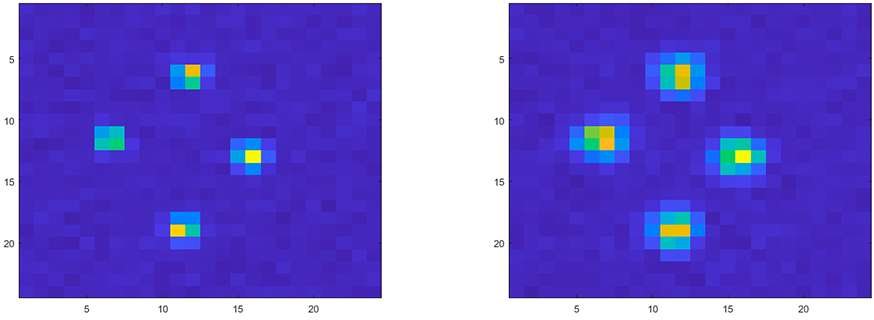
Image 1: A simple demonstration showing how spot size affects image consistency: A smaller spot size (left) captures the same object in four variations resulting in inconsistent shapes, while a larger spot size (right) preserves the object’s shape consistently on the image.
Why a 2-Pixel Spot Size Can Benefit Industrial Imaging
In industrial settings, hyperspectral imaging systems must provide accurate, real-time data to make reliable decisions on the production line. Here’s how a larger spot size and fewer effective pixels can improve performance in these environments:
- Reducing Artifacts: With a 1-pixel spot, the system captures finer details but is also more susceptible to artifacts. Any small details such like edges or very small objects in the scene can create artifacts along pixel boundaries, interfering with data interpretation and reducing reliability. The 2-pixel spot configuration minimizes this issue, producing smoother imaging and enhancing consistency.
- Improved Stability in Low SNR Conditions: The 2-pixel spot configuration enhances stability in low signal-to-noise ratio (SNR) conditions. This wider spot is more resilient to noise when capturing small targets and edge details, providing a smoother and more reliable data output. With the 2-pixel spot, the position of peaks and edges in target samples remains more stable, as each pixel captures a more comprehensive sampling of the optical point spread function. In contrast, a 1-pixel wide spot is more susceptible to random variations, i.e., noise due to fewer samples over the spot (optical point spread function), resulting in less reliable data. This resilience in low SNR conditions is crucial in industrial applications, ensuring reliable imaging for accurate, real-time decision-making.
- Stable Real-Time Performance: Industrial applications require stable data for reliable, real-time processing without distortions. The sharper image produced by a 1-pixel spot may be visually appealing, but this visual sharpness does not contribute to better data quality. The reliability of hyperspectral data matters more for industrial uses, where the 2-pixel spot size minimizes fluctuations and enhances data stability. This configuration ensures consistent performance and maintains the integrity of the hyperspectral data.
- Visual Sharpness vs. Data Quality: While a 1-pixel spot size can produce a sharper-looking image, this sharpness is mainly cosmetic and does not enhance the quality of the spectral data itself. Hyperspectral imaging for industrial use emphasizes accurate spectral data collection for analysis over visual sharpness. A 2-pixel spot size prioritizes data integrity, essential for reliable industrial applications.
When a Smaller Spot Size Can Be Advantageous?
In applications where data is not required in real-time, such as aerial imaging, a 1-pixel spot size may be advantageous. For these applications, data can be post-processed extensively, allowing for artifact and noise management. Here, the higher resolution afforded by a 1-pixel spot setup may be useful for detail-rich analysis.
Changing Perception: Why Less is Often More
For industrial applications, a smaller effective pixel count and a 2-pixel spot size offer distinct advantages. While customers may assume that more pixels and sharper visuals always translate to higher quality, in real-time industrial applications, increased noise and edge artifacts in a 1-pixel setup can compromise reliability. The 2-pixel approach achieves greater reliability, and reduced artifact sensitivity—resulting in improved overall performance that’s specifically tailored to industrial needs.
By focusing on high-quality, stable spectral data rather than visual sharpness, the 2-pixel spot size configuration aligns closely with the requirements of industrial applications. This understanding allows customers to make informed decisions, emphasizing data quality and performance over sheer pixel count.
In summary, while it may seem counterintuitive, a 2-pixel spot size can deliver superior real-time performance in industrial hyperspectral imaging, providing clearer, more reliable data where it matters most.