
SPECTROGRAPHS

High-performance optics for line-scan hyperspectral imaging
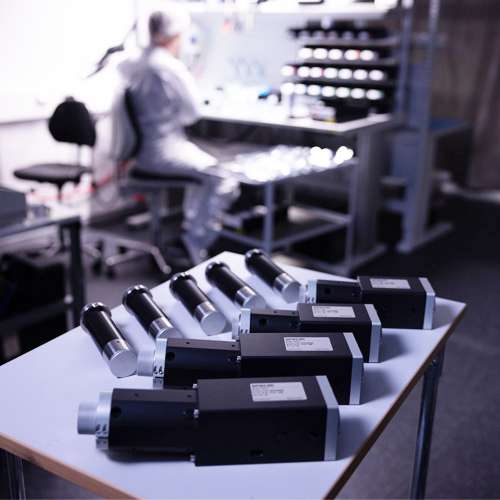
Across industry and research worldwide, thousands of advanced hyperspectral imaging systems are built around the Specim ImSpector spectrograph – the trusted optical core for high-performance spectral imaging.
The Specim ImSpector delivers distortion-free imaging, excellent spectral accuracy, and high optical throughput – setting the standard for line-scan hyperspectral performance. Each model is optimized for spectral resolution, detector size, spatial resolution, and imaging speed, ensuring dependable results in both industrial and scientific applications.
Wavelength ranges and configurations
Specim ImSpectors are available in the most commonly used hyperspectral wavelength ranges.


Specim ImSpector spectrographs provide a straightforward, high-performance, and cost-effective foundation for building tailored line-scan spectral imaging systems.
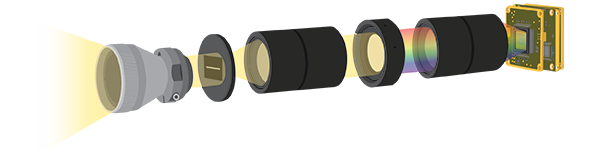
When combined with scientific CCD/CMOS cameras (VIS/VNIR) or InGaAs sensors (NIR), the ImSpector serves as the optical core of a complete line-scan hyperspectral imaging device.
Optical performance
you can rely on
Specim ImSpectors are built on decades of optical design expertise and are trusted in both Specim’s own hyperspectral cameras and numerous OEM and research systems worldwide. Their robust mechanical construction ensures long-term alignment stability and consistent performance in demanding environments.
WHAT OUR CUSTOMERS SAY
“Hundreds of leading research labs worldwide use CytoViva’s hyperspectral microscopy equipped with Specim’s ImSpector spectrographs to observe nanomaterials from 1 to 100 nm interacting with cells, tissue, and other matrixes. The system maps gold nanoparticles in unstained mammalian cells, demonstrating the ImSpector’s exceptional spectral purity, spatial resolution, and suitability for advanced scientific research.”
 Sam Lawrence, CEO, CytoViva
Ready to build your system around a reliable optical core?
Contact our team to discuss your application or request technical specifications.
Frequently Asked Questions
A spectrograph is an optical instrument that splits incoming light into wavelengths and forms a spectral image. It contains optics only, without a detector or electronics.
A hyperspectral camera includes optics, detector, mechanics, and electronics.
A spectrograph only disperses light and must be paired with a sensor and system mechanics.
No. All ImSpectors are optics-only. You integrate your own detector (CMOS, CCD, InGaAs).
The slit defines the imaged line and affects spectral resolution and throughput.
No. Frame rate is determined entirely by the detector used in your system.
No. Specim FX10 is a complete VNIR hyperspectral camera. V10E is a VNIR spectrograph designed for OEM systems.
Use an N-series ImSpector such as the N17E with an appropriate InGaAs detector.
Yes. A relay lens or adapter is typically required to match the f-number and image format.
Yes. All ImSpectors are line-scan (push-broom) spectrographs.
No. Snapshot imaging requires a different optical architecture.
Slit width, grating dispersion, focal length/magnification, and detector pixel size.
Lens quality, f-number, detector pixel size, magnification, and slit height.
Mechanical drawings are available. Optical data or Zemax models may require an NDA.
Yes. Specim offers compatible lenses and order-blocking filters.
Yes. Ensure correct f-number matching, detector size compatibility, and mechanical mounting.
The choice depends on wavelength range, detector format, spatial resolution, and system design. Specim can assist in selecting the optimal model.
Industrial sorting, recycling, material analysis, microscopy, biology, coatings, and remote sensing.
Different spectrograph models are available from the visual to the near-infrared range (380–1700 nm), and even up to 2500 nm in the SWIR range on demand.
Yes. NIR or SWIR spectrographs are typically used for evaluating material properties.
ImSpectors are OEM components, so pricing and lead times are provided upon request.