How to Acquire Hyperspectral Imaging Data in the Field: Techniques, Equipment, and Best Practices
Hyperspectral imaging (HSI) has become a vital tool for capturing detailed spectral information about materials and environments. While the technology is well-established in laboratory settings, acquiring high-quality data in the field presents a different set of challenges. Varying light conditions, equipment mobility, and environmental factors all impact data quality and usability.
This article outlines best practices for field-based hyperspectral imaging using Specim’s portable solutions – including the Specim FX camera mounted on a rotary scanner and the handheld Specim IQ – to help users to collect accurate and reliable data in real-world environments.

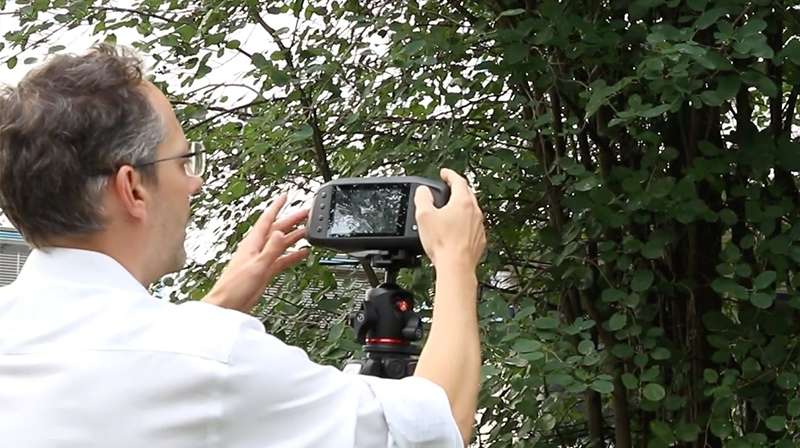
Introduction to Field-Based Hyperspectral Imaging
Unlike laboratory settings where lighting and sample position can be tightly controlled, field environments introduce variables such as (sun)light intensity and homogeneity, wind, terrain, and ambient temperature. These factors can introduce noise and reduce data consistency if not properly accounted for.
Despite these challenges, field-based HSI is critical across a range of sector, such as:

Geology (Mining and mineral exploration. Mineral mapping and rock identification in outcrops or drill cores.)

Environmental monitoring (e.g., vegetation health, soil conditions, water quality, species diversity, biomass estimation)

Agriculture and vegetation (e.g., crop health monitoring, early disease detection, and nutrient analysis)

Art and archaeology (e.g., Non-invasive documentation of monuments, paintings, or archeological sites—even when the artifacts can’t be moved indoors.)
In such applications, imaging systems must be portable, robust, and easy to deploy. Specim’s handheld and modular solutions – especially the Specim IQ and FX series combined with rotary scanners – are designed to meet these demands, offering flexible acquisition even in remote or uncontrolled conditions.
Equipment Selection and Setup
All Specim hyperspectral cameras operate using line-scan (pushbroom) imaging. Unlike traditional cameras that capture a full image in a single shot, line-scan cameras collect data one line at a time as either the camera or the target moves. This results in a detailed 3D datacube that includes both spatial and spectral dimensions. While this method delivers high precision, it requires careful coordination of scanning speed with camera frame rate. Besides, illumination, and focus needs to be acknowledged. To support diverse field imaging needs, Specim offers both rotary scanner based and handheld solutions.
Specim HSI Camera with Rotary Scanner
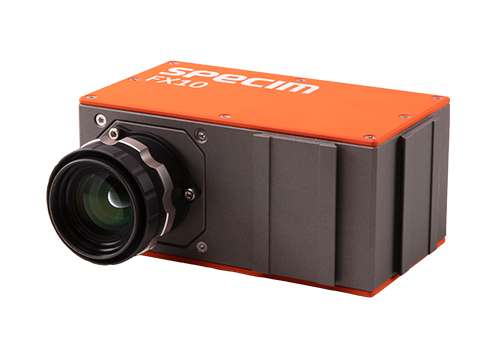
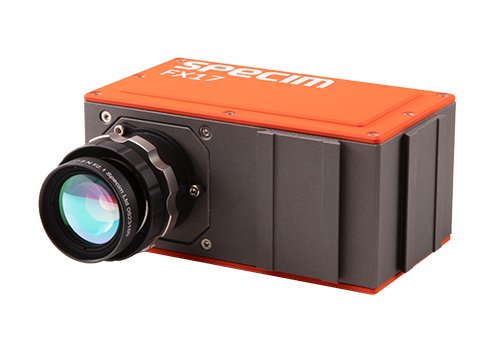
For VNIR (400–1000 nm) and NIR (900–1700 nm) imaging, the Specim FX10 and FX17 are commonly used in combination with the RS10 Rotary Scanner, which rotates the camera around the target to build a complete image. This is particularly effective when the object cannot be moved – such as trees, crops, or archaeological surfaces. The RS10 supports camera weight up to 10 kg, accommodating both FX10 and FX17 comfortably.

For heavier sensors, such as Specim SWIR (1000–2500 nm) camera, the RS50 Rotary Scanner provides a sturdier option with a 50 kg capacity. This makes it also suitable for integrating the Specim FX50 (MWIR; 2700–5300 nm) and FX120 (LWIR; 7500–12500 nm) cameras for specific thermal imaging use cases. However, field use in these MWIR and LWIR spectral ranges requires extra care, as thermal imaging is more sensitive to environmental factors, mostly dues to temperature fluctuations. In order to get an accurate radiometric calibration, a black body is needed with those thermal devices.


The field setups are typically run on Specim Lumo Scanner software, identical to what is used in lab environments. Power can be drawn from wall sockets when available or from field generators or battery packs when working in remote areas.
Specim IQ Handheld Hyperspectral Camera
For users needing maximum portability, the Specim IQ offers an all-in-one field solution covering the 400–1000 nm spectral range. The device integrates a camera, scanner, touchscreen, battery, and storage in a single device.

The IQ is tripod-mountable and easy to operate, even without a computer. Its detector uniformity allows it to compute reflectance directly from raw data, bypassing the radiance correction step required by other camera models when the white reference tile covers only partially the FOV. This simplifies data collection and accelerates workflows in the field without sacrificing measurement accuracy.
Best Practices for Data Acquisition in the Field
Capturing high-quality hyperspectral data outdoors involves more than just setting up the camera. Field variability requires careful attention to several key parameters:
1. Lighting Conditions
Aim to capture data under clear, cloud-free skies, as clouds can filter specific wavelengths and reduce signal quality. If artificial lighting is used (e.g., in greenhouses or shaded areas), ensure it provides broad, even spectral coverage without introducing unwanted reflections or shadows. The illumination should be as homogeneous as possible.
2. White Reference Placement
To convert raw data to reflectance, include a white reference tile in your scene, under the same lighting as your target. If you experience inconsistent lighting, use multiple white references and choose the one that best represents the scene’s lighting during processing.
3. Focus and Exposure
Sharp imaging detail requires accurate focusing. Use elements with high contrast to adjust manually. Then adjust integration time to balance signal strength and avoid saturation.
4. Equipment Protection and Stability
To protect your equipment from wind, dust, moisture, and vibrations, use stable tripods and weatherproof enclosures.
5. Radiometric calibration
Either you want to work in radiance or in reflectance, radiometric calibration is needed especially when the white reference tile does not cover the full FOV of the camera. The radiometric calibration is lens dependent, so, you must choose the right file when processing the data.

From Data to Insights: Pre-Processing and Quality Checks
Once the data is collected, it needs to be pre-processed to be usable and comparable over time and acquisition conditions. With the Specim FX series, this means converting the raw data into radiance using calibration files, and then into reflectance using the white reference tile. The Specim IQ provides with reflectance data automatically, thanks to its built-in pre-processing engine.
Regardless of which system you use, always validate the data quality before analysis. For example, healthy vegetation should show a distinct rise in reflectance at the red edge. To make future comparisons easier, it’s also helpful to write down key details—like focus settings, lighting, weather, and where the reference tile was placed. This is especially important if you plan to monitor the same area over time. One can also look at the atmospheric absorption bands to ensure the spectral calibration of the camera is correct.
Real-World Applications Across Industries
Field-based hyperspectral imaging is seeing growing adoption across sectors where in-situ analysis is essential. As the technology becomes more portable and accessible, organizations are using it to generate actionable insights directly in the field. You can explore real-world examples here.
Ready for the Field?
Whether you need lab-grade precision in forest research or a simple handheld tool for rapid crop inspections, Specim’s field imaging solutions help you make spectral decisions where they count. With decades of experience in hyperspectral innovation, Specim empowers professionals to collect actionable data anywhere, under almost any condition.
To learn more, contact our team.
Learn More – Watch the Webinar
Want to see these tools in action? Watch our on-demand webinar on field-based hyperspectral imaging, where Specim experts demonstrates best practices for using both rotary stage and handheld systems in real-world conditions. You’ll see how to optimize camera positioning, adjust for environmental conditions, and collect high-quality data in variable lighting.

Watch the webinar to gain practical tips and better understand how to bring laboratory-level spectral accuracy into the field.