Smarter Textile Sorting Solutions with Hyperspectral Imaging

Image 1:Different textile materials and fiber compositions present challenges for automated sorting and recycling processes.
Hyperspectral imaging enables automated identification and classification of textile materials based on their spectral characteristics.
By combining spectral information with AI-based analysis, textile sorting systems can distinguish between different fiber types and compositions, including materials that may appear visually similar.
Specim provides hyperspectral imaging cameras and AI-powered textile recognition solutions for automated textile sorting applications, from material analysis and system development to industrial sorting processes.
Why Is Automated Textile Sorting Important?
Textile sorting presents several challenges for recycling operators and sorting system manufacturers.
Garments contain a wide variety of natural, regenerated, and synthetic fibers, often combined in blended materials. Identifying these compositions is important when separating textiles for different recycling processes.
Manual sorting can identify garments by appearance, color, and labeling, but determining fiber composition is more challenging. Materials with similar visual characteristics may have different chemical compositions, while blended fabrics can contain multiple fiber types.
Automated sorting technologies can help address these challenges by providing consistent material information and supporting the classification of textiles according to their composition.
How Hyperspectral Imaging Identifies Textile Materials
Hyperspectral imaging (HSI) captures both spectral and spatial information, allowing materials to be analyzed based on how they interact with light at different wavelengths.
In the near-infrared (NIR) and short-wave infrared (SWIR) regions, textile fibers exhibit characteristic spectral features that can be used to distinguish between different materials.
Unlike conventional RGB imaging, which primarily captures visible appearance, hyperspectral imaging provides additional information about material composition.
This makes HSI particularly useful for textile sorting applications where visual inspection alone cannot reliably distinguish between different fiber types.
Key Capabilities
- Material identification: Spectral information supports the classification of natural, regenerated, and synthetic fibers.
- Fiber blend analysis: Spectral measurements can help identify and estimate the composition of blended textile materials.
- Spatial information: Hyperspectral imaging captures material information across the observed surface.
- Non-destructive measurement: Textile samples can be analyzed without chemical testing or destructive sample preparation.
- Automation: Hyperspectral cameras can be integrated into conveyor-based inspection and sorting systems.
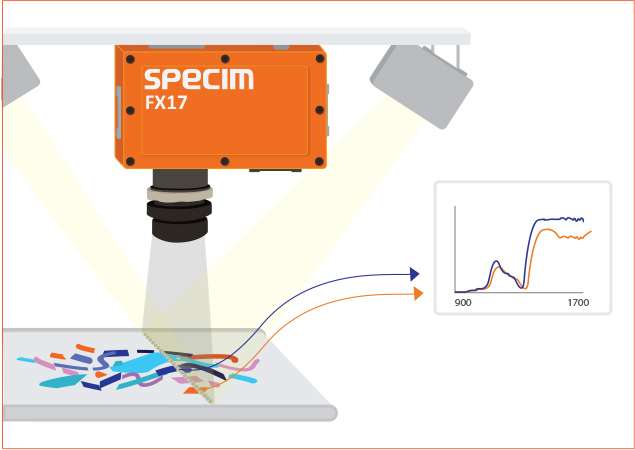
Image 2. Hyperspectral imaging captures spectral information that can be used to identify and classify textile materials.
Specim Solutions for Textile Sorting
Whether you’re developing an automated textile sorting system or seeking a ready-to-use material recognition solution, Specim offers hyperspectral imaging technology to meet diverse application needs.
Specim RETEX – AI-Powered Textile Recognition
Specim RETEX combines hyperspectral imaging and AI to identify textile materials and fiber compositions. Available in different configurations, RETEX supports applications ranging from material analysis and system development to industrial textile sorting.
Based on Specim’s internal testing, RETEX achieves classification accuracy of up to 99% for cotton, 98% for polyester, and 99% for polyamide.
Explore Specim RETEX

Specim Hyperspectral Cameras – For Custom Sorting Systems
For machine builders and system integrators developing their own textile sorting solutions, Specim offers hyperspectral cameras that can be integrated into industrial machine vision systems.
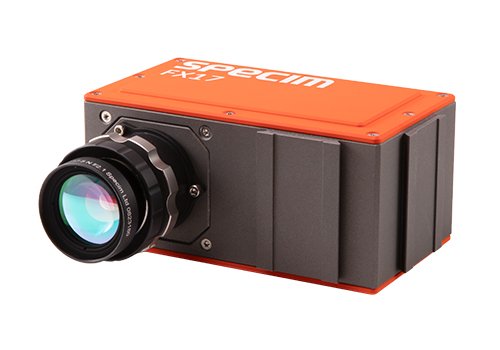
The Specim FX17 operates in the 900–1700 nm wavelength range and provides spectral information suitable for identifying different textile materials.
Hyperspectral cameras can be combined with application-specific classification algorithms, RGB imaging, and other sensing technologies to develop automated sorting systems.
Explore Specim Hyperspectral Cameras
Identifying Different Textile Materials and Fiber Blends
Hyperspectral imaging can provide spectral information for identifying a wide range of textile materials, including:
- Cotton
- Polyester
- Cotton–polyester blends
- Polyamide
- Viscose
- Wool
- Acrylic
- Elastane-containing materials
Material identification depends on the spectral characteristics of the samples, the wavelength range used, and the classification models developed for the application.
Hyperspectral imaging can also support the detection of different materials within the same field of view, providing information for subsequent classification and sorting decisions.
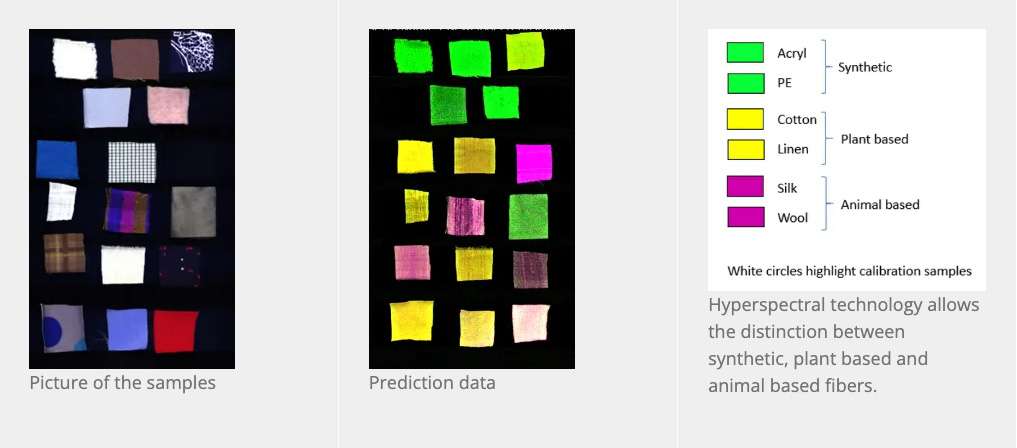
Image 3: Hyperspectral identification of textile samples. Left: Fabric samples used in the measurement. Middle: Material classification results based on hyperspectral imaging. Right: Color legend showing the identified textile materials.
Spectral Information for Textile Classification
Different textile materials interact with infrared light in different ways.
By analyzing these spectral differences, hyperspectral imaging systems can distinguish materials that may appear similar in conventional images.
The resulting classification information can be used by automated sorting systems to separate textile materials according to predefined categories.

Image 4: Near-infrared hyperspectral imaging provides spectral information that can be used to identify and classify textile materials.
Hyperspectral Textile Sorting in Practice: PICVISA
Spanish sorting technology company PICVISA has integrated the Specim FX17 hyperspectral camera into its automated textile sorting solutions.
PICVISA combines hyperspectral imaging with complementary sensing technologies and AI-based classification to identify textiles by material composition, color, and garment characteristics.
At Coleo Recycling in Galicia, Spain, PICVISA’s technology is used in a facility handling approximately 5,000 tons of textile waste annually.
The application demonstrates how hyperspectral imaging can be integrated into industrial textile sorting systems to provide material information for automated classification and separation.
This technology is a game-changer. It enables us to identify materials and compositions of garments for pre-selection before recycling, providing a complete analysis with excellent spectral resolution.
Daniel Carrero, Technical Director, PICVISA

Image 5: PICVISA’s automated textile sorting installation incorporates the Specim FX17 hyperspectral camera for material identification and classification.
Business Value for Textile Sorting Operations
Automated textile material identification can support different stages of textile sorting and recycling processes.
For sorting system manufacturers, hyperspectral imaging provides a way to integrate material-specific information into automated machine vision systems.
For textile sorting operators, automated classification can help reduce dependence on manual material identification and support consistent sorting decisions.
Key opportunities include:
- Automated material identification: Classification of textile materials based on spectral information.
- Flexible sorting categories: Classification models can be developed for different material types and compositions.
- Integration with existing technologies: Hyperspectral imaging can complement RGB cameras, AI-based vision systems, and other industrial sensors.
- Material separation: Classification information can support the preparation of textile materials for subsequent processing.
- Application-specific solutions: Different camera and recognition system configurations can be selected according to operational requirements.
The resulting material information can support more informed sorting decisions and help operators develop processes suited to their target material streams.
Find the Right Textile Sorting Solution
Whether you are developing an automated textile sorting machine, evaluating textile material identification technologies, or looking for an AI-powered recognition solution, Specim can help you explore the available options.
Our team can discuss your application, help evaluate suitable technologies, and support testing with your textile samples.
Discuss Your Textile Sorting Application